HVAC Glossary: Heating and Cooling Terms Explained
A plain-English A–Z guide to HVAC terms, parts, ratings, refrigerants, and technician language for Phoenix homeowners.
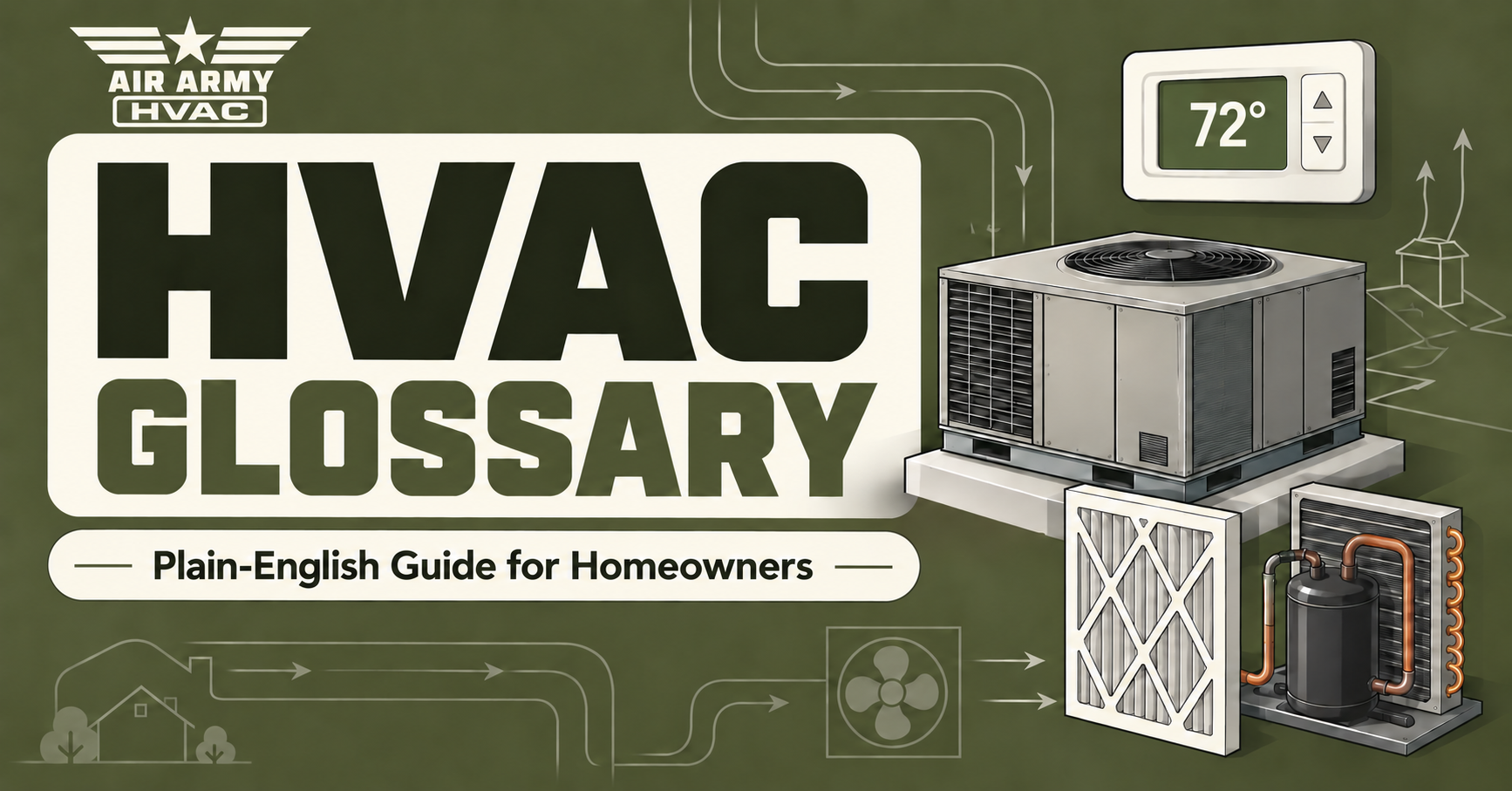
HVAC words can sound like a different language. This plain-English glossary explains the terms Phoenix homeowners are most likely to hear from a technician, see on an estimate, or find on an equipment label.
How to use this guide: Scroll to a letter or use your browser’s Find tool to search for a word from your quote. These short definitions help you ask better questions. They do not replace testing at the equipment.
A–Z: A · B · C · D · E · F · G · H · I · J · K · L · M · N · O · P · Q · R · S · T · U · V · W · X · Y · Z
A
A/C or AC
Air conditioning. The system that removes heat and moisture from indoor air.
A2L refrigerant
A newer refrigerant type with lower climate impact. It is called mildly flammable, so equipment and service rules are different.
Air balance
Adjusting airflow so each room gets the right amount of heating or cooling.
Air filter
A replaceable filter that catches dust before it reaches the equipment. A dirty filter can block airflow.
Air handler
The indoor part of many split systems. It holds the blower and indoor coil.
Airflow
The movement of air through the system and home. Good airflow is needed for comfort and equipment life.
Amp or amperage
A measure of electric current. Technicians check amps to see if a motor or compressor is working too hard.
AHRI
The Air-Conditioning, Heating, and Refrigeration Institute. Its directory helps confirm tested, matched equipment.
Auxiliary heat
Backup electric heat used by some heat pumps. It can use more power than normal heat-pump operation.
B
Blower motor
The motor that pushes air through the indoor coil, ducts, and vents.
BTU
British thermal unit. A small unit used to measure heat.
BTU per hour (BTU/h)
A measure of heating or cooling capacity. A 36,000 BTU/h system is commonly called a 3-ton system.
C
Capacitor
A small electrical part that helps a motor or compressor start and run. Phoenix heat is hard on capacitors.
CFM
Cubic feet per minute. It tells us how much air is moving.
Coil
Tubing with metal fins that transfers heat. Most central systems have an indoor and outdoor coil.
Comfort advisor
A person who helps choose a new HVAC system. Ask how the recommended size and equipment were selected.
Compressor
The main pump in the refrigerant system. It moves refrigerant and is one of the most expensive parts.
Condenser coil
The outdoor coil during cooling. It releases heat from your home outside.
Condensate
Water pulled from indoor air while cooling. It leaves through a drain.
Condensate drain line
A pipe that carries water away from the indoor coil. A clog can cause leaks or a shutdown.
Contactor
An electrical switch that sends power to the outdoor unit.
COP
Coefficient of performance. It compares heat output with energy used. Higher is better under the test conditions.
Crankcase heater
A small heater that protects a compressor while the system is off.
Cycle
One period when the system turns on, runs, and turns off.
D
Damper
A small door inside ductwork that changes or stops airflow.
Defrost cycle
A heat-pump mode that melts ice from the outdoor coil. Steam during defrost can be normal.
Delta T or temperature split
The difference between return-air and supply-air temperatures. It is one clue, not a complete diagnosis.
Dehumidification
Removing moisture from indoor air.
Disconnect
A safety switch near the outdoor unit that lets a technician shut off power.
Ductwork
The metal or flexible passages that carry air around the home.
Ductless mini-split
A system with an outdoor unit and one or more indoor heads. It does not need traditional ducts.
Dual-fuel system
A heat pump paired with a gas furnace.
E
ECM motor
An electronically controlled motor that can use less power and control airflow better than many older motors.
EER2
Energy Efficiency Ratio 2. It measures cooling efficiency at one test condition. Higher is more efficient.
Efficiency
How much heating or cooling a system gives for the energy it uses.
Electric heat strip
Electric heating elements inside an air handler. They provide backup heat but may use a lot of power.
Evaporator coil
The indoor coil during cooling. It absorbs heat from indoor air.
Expansion valve or TXV
A part that controls refrigerant entering the indoor coil.
F
Fan coil
An indoor unit with a coil and blower.
Filter drier
A refrigerant-line part that catches moisture, acid, and small debris.
Float switch
A safety switch that can stop the system when a drain pan or line fills with water.
Fresh-air intake
A controlled opening or duct that brings outdoor air inside.
Furnace
Equipment that heats air, then uses a blower to move it through ducts.
G
Gas furnace
A furnace that burns natural gas or propane.
Gauge pressure
The pressure shown on service gauges. Pressure must be compared with temperatures and other data.
GWP
Global warming potential. It compares how strongly a gas can warm the climate. Lower is better.
H
Heat exchanger
A furnace part that keeps combustion gases away from the air sent into the home. Damage can be a safety issue.
Heat pump
A system that cools and heats by moving heat. It sends heat outside in summer and inside in winter.
Heat strip
Another name for electric resistance heat inside an air handler.
HSPF2
Heating Seasonal Performance Factor 2. It rates seasonal heat-pump efficiency. Higher is better.
Humidity
The amount of water vapor in the air.
HVAC
Heating, ventilation, and air conditioning.
I
IAQ
Indoor air quality. It includes particles, odors, chemicals, humidity, and ventilation.
Inverter
Electronics that let a compressor or motor change speed instead of only turning fully on or off.
Insulation
Material that slows heat moving through walls, ceilings, and ducts.
J
Manual J load calculation
A detailed calculation of how much heating and cooling a home needs.
Junction box
A covered box where electrical wires connect.
K
Kilowatt (kW)
A measure of electric power. One kilowatt equals 1,000 watts.
Kilowatt-hour (kWh)
The unit used to bill electric energy. One kWh is 1,000 watts used for one hour.
L
Latent heat
Heat tied to moisture in air. Removing latent heat means removing humidity.
Leak search
Testing to find escaping refrigerant. Adding refrigerant alone does not fix the cause.
Line set
The two copper refrigerant lines joining the indoor and outdoor units.
Load calculation
The math used to choose system size. Manual J is the common home method.
Low-voltage wiring
Small control wires that connect the thermostat and equipment.
M
Matched system
Indoor and outdoor equipment tested to work together.
MERV
Minimum Efficiency Reporting Value. Higher-MERV filters catch smaller particles but may restrict airflow if the system is not designed for them.
Micron
A tiny unit. A micron gauge confirms air and moisture were removed from refrigerant lines.
Mini-split
Another name for a ductless system.
Modulating system
Equipment that can make many small changes in output.
N
Nameplate
The equipment label with model, serial number, electrical data, and refrigerant.
NATE
North American Technician Excellence, a voluntary certification program.
Negative pressure
Lower air pressure that pulls air in from nearby spaces.
Nominal size
The general equipment size, such as 3 tons. Actual rated capacity may differ.
O
Outdoor unit
The outside part of a split system. It usually holds the compressor, outdoor coil, and fan.
Oversized system
A system with too much capacity. It may short-cycle, create uneven comfort, and wear faster.
Ozone depletion potential (ODP)
A measure of how much a chemical can harm the ozone layer.
P
Package unit
A complete system in one cabinet. Many Phoenix package units sit on the roof.
Plenum
A large box that collects or sends air between equipment and ducts.
Preventive maintenance
Planned service that checks, cleans, and tests the system before a breakdown.
Pressure switch
A safety or control switch that reacts to air, gas, or refrigerant pressure.
PSC motor
Permanent split capacitor motor. A common older-style motor that runs at set speeds.
Psychrometrics
The study of air, temperature, and moisture.
Q
Quality installation
An installation with correct sizing, airflow, charge, wiring, drainage, sealing, and startup tests.
R
R-22
An older refrigerant often called Freon. New R-22 has not been produced or imported in the U.S. since 2020, but recovered or reclaimed R-22 may still be used.
R-410A
A common refrigerant in many existing systems. It has high GWP and is being phased down for many new-equipment uses.
R-32
A lower-GWP A2L refrigerant used in some new systems. Equipment must be made for it.
R-454B
A lower-GWP A2L refrigerant used in many new home systems. It needs equipment designed for R-454B.
Refrigerant
A fluid that carries heat through the system.
Refrigerant charge
The amount of refrigerant in a system. Too much or too little can hurt performance and equipment.
Return air
Air pulled from the home back to the equipment.
Reversing valve
A heat-pump part that changes refrigerant flow to switch between heating and cooling.
Rooftop unit
A package unit installed on a roof. It is common in Phoenix.
Run capacitor
A capacitor that helps a motor or compressor run.
S
Sensible heat
Heat that changes air temperature but not moisture.
SEER2
Seasonal Energy Efficiency Ratio 2. It estimates seasonal cooling efficiency. Higher is more efficient under the test method.
Setpoint
The temperature chosen on the thermostat.
Short cycling
When a system turns on and off too often.
Single-stage system
Equipment with one main level of output: fully on or off.
Split system
A system split between indoor and outdoor cabinets.
Static pressure
Resistance to airflow inside the duct system. High pressure can reduce airflow and strain the blower.
Subcooling
How far liquid refrigerant is below its condensing temperature. Technicians use it with other readings.
Superheat
How far refrigerant vapor is above its boiling temperature. Technicians use it with other readings.
Supply air
Conditioned air leaving the equipment and going to rooms.
Surge protector
A device that helps protect electronics from voltage spikes.
T
Temperature split
The difference between return-air and supply-air temperatures. Also called Delta T.
Thermostat
The control that measures room temperature and tells the system when to run.
Ton or tonnage
A measure of cooling capacity, not weight. One ton equals 12,000 BTU/h.
Two-stage system
Equipment with a lower and higher output level.
TXV
Thermostatic expansion valve. It controls refrigerant entering a coil.
U
Undersized system
A system with too little capacity. It may run a long time and still miss the setpoint.
UV light
An ultraviolet lamp near a coil or in ducts. It may control growth where light shines but does not remove dust.
V
Vacuum
A deep vacuum removes air and moisture from refrigerant lines before startup.
Variable-speed system
Equipment that changes output or blower speed in small steps.
Ventilation
Bringing outdoor air in and sending stale air out in a controlled way.
VOC
Volatile organic compound. Gases from paint, cleaners, furniture, and other products.
Volt or voltage
The electrical force that pushes current through a circuit.
W
Watt
A measure of electric power.
Wet-bulb temperature
A temperature reading that includes the effect of moisture in air.
Whole-home air cleaner
A larger filter or cleaner installed in the central system.
X
X13 motor
A common name for a constant-torque ECM blower motor. It is not the same as a fully variable-speed motor.
Y
Y wire
The thermostat wire that calls for cooling or compressor operation.
Y1 and Y2
Thermostat signals for first-stage and second-stage cooling or heat-pump operation.
Z
Zone
One area of a home controlled separately.
Zoning system
Thermostats and motorized dampers that send heating or cooling to selected areas.
Three terms every Phoenix homeowner should know
SEER2
This is the seasonal cooling-efficiency rating. It helps compare equipment, but a high rating cannot make up for poor sizing, low airflow, leaky ducts, or a weak installation.
Static pressure
This is the resistance your blower pushes against. High static pressure is like breathing through a small straw. It can reduce comfort and shorten equipment life.
Refrigerant charge
Refrigerant is not fuel and should not be used up. If a system is low, there may be a leak. A proper visit should include more than adding refrigerant.
Need help understanding an HVAC quote?
Ask the contractor to show you the problem, explain the test results, and list the exact model numbers. For a replacement, ask for the load calculation, matched-system rating, warranty terms, and full installed price.
Air Army serves Phoenix, Scottsdale, Tempe, Chandler, Mesa, Gilbert, Glendale, and nearby areas. For a clear explanation without high-pressure sales tactics, call 480-992-1234. You can also learn about AC repair, compare AC replacement options, or review our HVAC maintenance plans.
Trusted reference sources
- U.S. Department of Energy: Heat Pump Systems
- ENERGY STAR: Heating and Cooling
- U.S. EPA: R-22 phaseout
- U.S. EPA: HFC refrigerant phase-down
- AHRI Directory of Certified Product Performance
Last reviewed September 2026. Rules, refrigerants, and efficiency standards can change. Follow the label and instructions for your exact equipment.
Good information. Real help when you need it.
Something not working?
Get a diagnosis and understand your repair options before deciding what to do.
Get AC repair →Considering replacement?
Compare systems and published installed prices, then talk with our team.
See installed prices →Stay ahead of the season.
Explore memberships with two annual tune-ups and ongoing member benefits.
Explore maintenance plans →